





Wedding Stage Lighting: A Designer's Guide to Atmosphere, Layering, and Reliable Gear

Lighting is the quietest decision at most weddings, and the one guests remember most. A room that is simply bright feels like a conference; a room that is shaped by light feels like an occasion. The difference is rarely the budget — it is whether the light was planned as a design problem rather than treated as an afterthought.
This guide is written for couples, planners, and DJs who want the result to look intentional. We will skip the buzzwords and walk through how professional event lighting is actually layered, which technical details matter for skin tones and photography, and how to build a dependable rig from KeoBin's fixtures for venues of any size.
Last updated: August 2026
In this guide
- Start with the venue, not the catalogue
- The four layers of wedding light
- Color temperature and rendition
- Control systems: DMX, sound-active, and app
- Matching fixtures to the space
- Power, safety, and logistics
- A KeoBin build for three budgets
- Mistakes worth avoiding
- A quick planning checklist
- Frequently asked questions
- Related reading
Start with the venue, not the catalogue
Before looking at a single fixture, answer four questions about the space. They determine everything else:
- Ceiling height and rigging points. A 12-foot ballroom behaves nothing like a 30-foot clear-span tent. Low ceilings push you toward uplighting and floor-based wash; tall spaces can use truss and hanging fixtures.
- Power availability. Count the dedicated circuits and their amperage. A common failure mode is daisy-chaining too many fixtures on one wall outlet and tripping the breaker mid-first-dance.
- Indoor, outdoor, or tented. Outdoor and tent setups add weatherproofing, run-length limits on cable, and wind load on stands. Battery-powered fixtures change the equation completely here.
- Curfews and sightlines. Some venues require fixtures to be dark by a certain hour or ban haze and fog. Confirm before you spec the gear.
If you only do one thing, do this: visit the venue at the time of day your event runs, and photograph it with the house lights on. That single reference tells you more than any spec sheet.
The four layers of wedding light
Professional designs almost never use one kind of light. They stack four layers, each with a job:
1. Base / ambient light
This is the even, comfortable light that lets people eat, read a menu, and move safely. It is usually the venue's house lighting dimmed, sometimes warmed. Keep it subtle during dinner — guests should feel intimacy, not interrogation.
2. Accent and uplighting
Uplights placed at the floor, aimed at walls, columns, or drapes, turn a flat room into a designed one. A PAR wash in a single restrained color (or a slow crossfade between two) is the single highest-impact, lowest-risk upgrade most weddings can make.

3. Feature and focus
Spotlight the things that matter — the couple during speeches, the cake, the head table, the first-dance. A focused, properly exposed key light is what your photographer will quietly thank you for.
4. Effect and energy
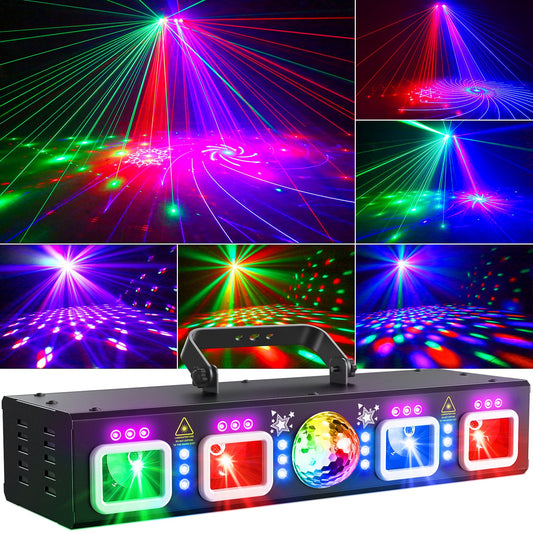
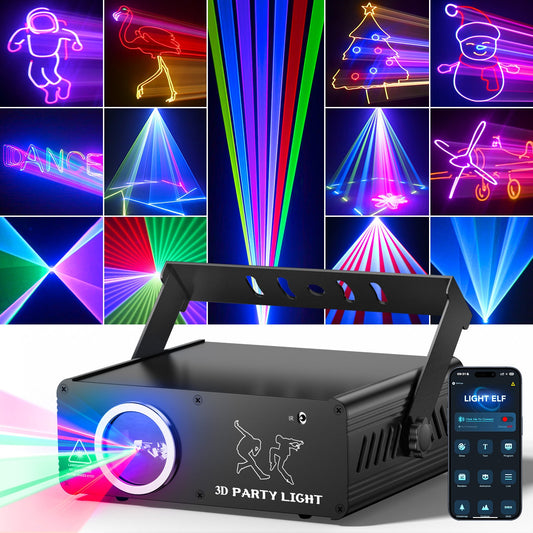
This is the "party" layer: moving patterns, laser animation, strobe, haze-caught beams. It should stay off during dinner and arrive with the dance floor. Used well, it signals a shift in energy; used constantly, it exhausts the room.

Color temperature and rendition: why your photos depend on it
Two specifications decide whether people look good under your lights.
Color temperature, measured in kelvin, describes whether light reads warm or cool. Warm light (roughly 2700–3200K) is forgiving on skin and reads as romantic; cool, daylight-balanced light (5000K+) reads clinical. Most wedding designs live in the warm range for dinner and only introduce saturated color for effect.
Color Rendering Index (CRI) measures how accurately a light reveals the true color of what it hits. A low-CRI fixture can make a ivory dress look grey and a flushed cheek look odd. For anything near the couple or the food, favor high-CRI sources. Both concepts are worth understanding before you buy — see the references on color temperature and the Color Rendering Index. For formal design practice, the Illuminating Engineering Society (IES) publishes the underlying lighting standards.
Control systems: DMX, sound-active, and app control
"How is it controlled?" matters more than "how many watts?" for a smooth event.
- DMX512 is the industry-standard digital protocol (defined by the ANSI E1.11 standard, maintained by ESTA) that lets one console address many fixtures precisely. It is the right choice when you want a rehearsed, repeatable look.
- Sound-active mode lets fixtures react to music automatically — great for low-staff events, less precise.
- App / remote control is the practical sweet spot for DIY weddings: presets, timing, and color changes from a phone, no console required.
Our recommendation for most weddings: choose fixtures that support all three, run them in app or sound-active mode for safety, and only reach for DMX when you have someone to operate it.
Matching fixtures to the space
Banquet hall
Uplighting on every column, a warm dimmed base, and a focused key light on the head table. Effects stay on the dance floor at the far end. Battery fixtures are optional here since power is plentiful.
Tented or outdoor
This is where battery-powered, weather-aware fixtures earn their keep. Run uplights on internal batteries to avoid long cable runs across grass, and keep stands weighted against wind.


Intimate backyard
Less is more. A pair of warm battery uplights for ambience, two or three uplights, and one effect fixture for the dance portion. Restraint reads as tasteful.
Power, safety, and logistics
- Distribute load. Spread fixtures across circuits; a rough rule is to keep each circuit well under its rating and never share a circuit with the caterer's equipment.
- Secure stands. Sandbag or base-weight every tripod. A falling fixture is the fastest way to end an evening.
- Manage cable. Tape or ramp over any run crossing a pathway. Trip hazards are a liability, not a detail.
- Plan for failure. Bring one spare fixture and the right adapters. The best designs have a fallback that still looks good unplugged.
A KeoBin build for three budgets
These are starting points using KeoBin's current lineup, not rigid prescriptions. Internal links go to the live product pages.
Essentials — intimate or backyard
battery uplights for ambience, plus a pair of 12×16W Rechargeable Par Lights for uplighting. Simple, battery-friendly, no console.

Elevated — banquet or tented
Add a DJ light with stand for the head-table key light, and a L2500 6-in-1 disco light for the dance floor.
Full production — larger reception
Scale the par lights to a full uplight ring, add L2400 3D RGB laser lights for animated effect, and run the whole system on DMX through a L2700B 7-in-1 stage lighting system.

Mistakes worth avoiding
- Coloring everything, always. Saturated light is a seasoning, not the meal. Keep dinner warm-neutral.
- Underestimating setup time. A full rig takes longer to place and focus than the run-through suggests. Build in a buffer.
- Ignoring the photographer. A two-minute conversation with your photographer about key light and white balance prevents a gallery of mismatched skin tones.
- One circuit to rule them all. See "Power" above — this is the most common on-the-night failure.
A quick planning checklist
- Photograph the venue at event time with house lights on.
- List circuits and rigging points; note curfews and haze rules.
- Choose a warm base, an uplight color, and one effect for the dance floor.
- Confirm CRI and color temperature of any fixture near the couple.
- Decide control mode: app/sound-active for DIY, DMX if operated.
- Weight every stand; tape every cable; pack one spare fixture.
Frequently asked questions
Do I need a lighting designer?
Not for most weddings. A planned four-layer approach with app-controlled fixtures is very achievable by a capable DJ or a detail-oriented couple.
How many uplights do I need?
A practical rule is one uplight per 8–10 feet of wall you want to treat, or one per architectural feature (column, doorway, drape). Quality of placement beats quantity.
Is haze safe indoors?
It depends on the venue. Many ban curfews on haze or fog. Ask first; without it, beam effects are far less visible.
Can battery fixtures really last the night?
KeoBin's rechargeable pars are rated for extended runtime on a single charge; for a long reception, keep chargers on a separate circuit and rotate if needed.
Conclusion
Great wedding lighting is not about the most fixtures — it is about four deliberate layers, warm and accurate color where it counts, and gear you can trust to run all night. Start from the room, plan the layers, and let the effect layer arrive with the dancing.
Browse the full KeoBin lighting collection to build a setup that fits your venue and your evening.
Related reading
If you are building a setup from this guide, these deeper dives cover the specifics:
- How Many Party Lights Do I Need? The Deep-Dive Guide to Room Size and Stage Lighting — sizing your rig to the room.
- Sound-Activated vs DMX vs App-Controlled Party Lights — choosing the right control mode.
- What Are PAR Lights? A Beginner's Guide to LED PAR Lighting — the workhorse of accent uplighting.
- Beginner DMX512 Lighting Setup Guide for Small Events and Home Parties — running a rehearsed, repeatable look.
- Disco Laser Light vs. Disco Ball Light: Which Is Better for Your Party? — picking the effect layer for the dance floor.
- How to Sync Music and Lights for a Birthday Party — beat-matched, sound-active DIY disco.
- How to Use Laser Lights for a Home Party — a compact effect that fills the room.
- Rechargeable & Battery-Powered Party Lights: The 2026 Buyer's Guide — cut the cords at the venue.
Background: The color temperature overview is useful for understanding warm and cool wedding-lighting choices.