





Rechargeable & Battery-Powered Party Lights: The 2026 Buyer's Guide

The single biggest limitation in event lighting has never been brightness — it has been the wall socket. The moment you step outside a ballroom, every fixture becomes a problem of where the power is, how long the cable has to run, and how to keep people from tripping over it. Battery-powered fixtures remove that constraint entirely, and they have quietly become the most practical upgrade for weddings, backyards, and tented events.
This guide explains what actually matters when you buy wireless party lights in 2026: how battery capacity translates into real runtime, which specifications separate a toy from a tool, and how to build a dependable rig from KeoBin's current lineup. For the broader foundation on layering light for an event, our complete wedding lighting guide covers the design side.
Last updated: August 2026
Why battery power changes the setup
A traditional rig is a logistics problem disguised as a lighting problem. You place a fixture where the light needs to be, then realize the nearest outlet is 40 feet away across a dance floor. The result is cable ramps, extension reels, and a breaker that trips the moment the caterer's warmer kicks in on the same circuit.
A rechargeable fixture flips the order. You place the light where it belongs and the power comes with it. That single change has three practical payoffs:
- No trip hazards. A floor-level uplight with an internal battery needs zero cable across a walkway — the single largest liability in DIY event lighting disappears.
- Placement freedom. Columns, trees, tent poles, and the far corner of a backyard all become valid lighting positions, not "too far from an outlet."
- Faster teardown. No cable to coil, no reel to wind. For a mobile DJ or a couple doing their own setup, this is the difference between a 90-minute pack-down and a 20-minute one.
The trade-off is real but manageable: battery fixtures cost more per lumen than wired ones, and you have to think about charging. The rest of this guide is about making that trade-off work in your favor.

The specifications that actually matter
Marketing copy leads with "super bright" and a watt number. Neither tells you what you need. Four specifications do.
Battery capacity: read watt-hours, not just "mAh"
A milliampere-hour (mAh) figure is only meaningful at a stated voltage. The honest unit is watt-hours (Wh) — it tells you the total energy stored. A fixture rated for, say, 150 Wh can in principle deliver 150 W for one hour, or 15 W for ten. Runtime is simply battery energy divided by what the fixture actually draws at the brightness you use. The underlying chemistry is covered well in the general reference on rechargeable batteries.
Brightness: lux at a distance, not raw lumens
Lumens measure light leaving the fixture; lux measures how much reaches the wall. For uplighting, what matters is output at 2–3 meters. A high-lumen fixture with a wide, unfocused beam can deliver less wall brightness than a lower-lumen fixture aimed well. When a spec sheet gives lux at a distance, trust that over lumens alone.
Color: RGBWA+UV vs RGB
Basic RGB gives you the primaries. Adding white and amber (RGBWA) lets the fixture produce believable warm tones instead of a magenta-ish "warm" that reads as artificial in photos. UV adds a subtle blacklight layer for effect. For anything near skin or food, RGBWA is the bar to clear.
Ingress protection: the IP rating
If the fixture will see dew, splashes, or a covered patio, the IP rating matters. IP rating is the standard measure of protection against solids and water — see the reference on the IP code for what each digit means. A higher second digit (IPX4 splash-resistant, IPX5 jet-resistant) buys peace of mind outdoors even when the fixture is nominally "indoor."
How long will it really run?
Runtime on a box is a best-case number at minimum brightness. Plan for the brightness you will actually use.
A practical way to estimate: find the fixture's draw at your typical setting (often listed per mode, or derivable from Wh ÷ claimed hours at that mode), then assume you will run it at 60–70% of its brightest useful level for an event. A fixture that claims "20 hours at eco" may give you 6–8 solid hours at a lively wash — usually enough for a reception, but not a full all-night club.
Two habits keep a wireless rig from dying mid-event:
- Charge on a separate circuit. Keep chargers plugged in away from the action; most battery pars recharge while nominally "off" if the venue allows.
- Rotate, don't gamble. For a long night, run half your uplights on battery and half wired, or swap a depleted unit during a natural lull (speeches, meal service).

Control: app, sound-active, and DMX
Wireless does not mean dumb. The same control modes that matter for any event lighting apply here, and battery fixtures increasingly support all three:
- App / remote control is the practical default for DIY events — presets, timing, and color from a phone, no console.
- Sound-active mode lets fixtures react to music automatically; ideal when no one is operating them.
- DMX512 is the industry-standard protocol (maintained under the ANSI E1.11 standard by ESTA) for precise, repeatable control when you have an operator. For an entry point, our DMX512 setup guide walks through a small rig.
Our recommendation matches the broader rule in our control-mode comparison: run app or sound-active for safety, reach for DMX only when someone is driving the look.
Matching wireless lights to the scene
Backyard or intimate outdoor
Less is more. A strand of warm battery uplights for ambience plus two or three rechargeable pars for uplighting is a complete, cable-free design. Restraint reads as tasteful.
Tented wedding
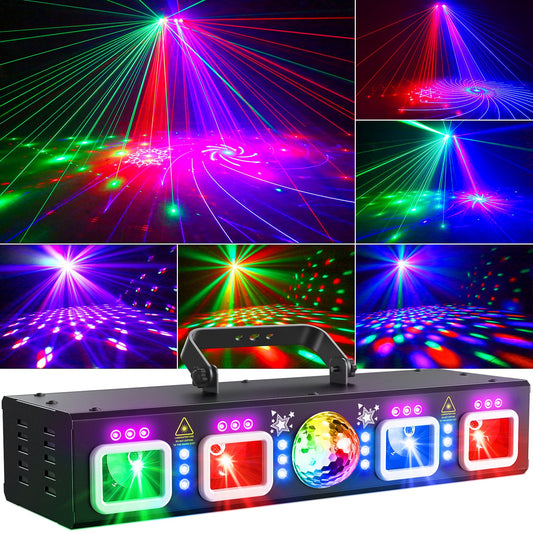
Tents rarely have power at the pole. Battery uplights placed at the base of each pole give you architecture without running cable through foot traffic. Add a 6-in-1 disco fixture on a weighted stand for the dance floor effect.

Mobile DJ / bar
For a rig that lives in your car, battery fixtures mean you can take the show anywhere a gig appears. The L2700B 7-in-1 system packs wash, effect, and control into one stand — useful when the venue's power is uncertain.
Weather, water, and stands
- Know your rating. Even "indoor" fixtures survive a covered patio if they are IP-rated for splash. Check the second digit of the IP code before you trust them outside.
- Condensation is the quiet killer. Battery compartments hate moisture. Bring fixtures in after the night; don't leave them out in morning dew.
- Weight the stands. Battery fixtures are lighter, which makes them easier to blow over. Sandbag or base-weight every tripod exactly as you would a wired one. The Illuminating Engineering Society treats safe, glare-free installation as part of good design, not an afterthought.
A KeoBin build for three budgets
Starting points using current KeoBin fixtures, not rigid prescriptions. Internal links go to live product pages.
Essentials — backyard or intimate
battery uplights for ambience plus a pair of 12×16W Rechargeable Par Lights for uplighting. Fully wireless, no console.
Elevated — tented or small venue
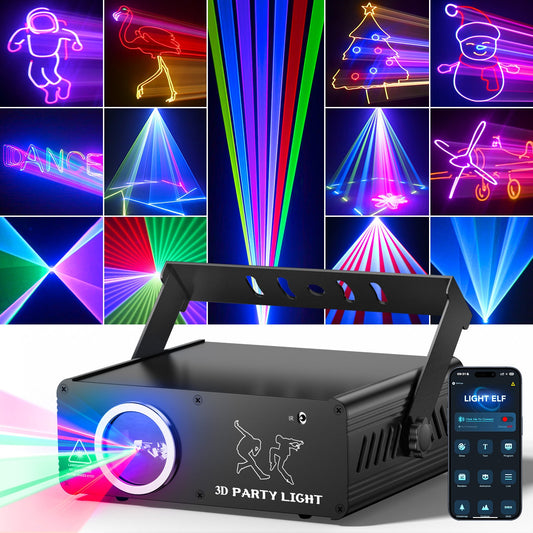
Add a DJ light with stand for a focused key light and an L2400 3D RGB laser for room-filling beam with restrained haze.
Full production — larger reception
Scale the rechargeable pars to a full uplight ring, add the L2500 6-in-1 for animated effect, and run the whole system on DMX through the L2700B 7-in-1 stage lighting system.
Mistakes worth avoiding
- Trusting the box runtime. Plan for 60–70% of the headline number at the brightness you will use.
- Buying RGB when you need warm. Without amber/white, "warm" looks artificial in photos. Spend up to RGBWA+UV.
- Forgetting to charge before load-in. A dead battery is worse than no battery — it looked like it would work.
- Skipping stand weight. Lighter fixtures blow over easier, not harder.
Shop KeoBin's wireless lineup
Ready to cut the cords? These are the KeoBin fixtures we actually recommend for battery-powered setups:
- KeoBin 12×16W Rechargeable Par Lights — 8-hour battery uplights with RGBWA+UV, DMX and remote. The core of any wireless rig.
- Browse all KeoBin Par Lights — wash, uplight, and battery options.
- Shop the full Party & DJ Stage Lights collection for sound-active and app-controlled fixtures.
Frequently asked questions
Can battery lights really last a full reception?
For most receptions, yes — a quality rechargeable par covers several hours at a useful wash level. For an all-night club, plan rotation or keep chargers on a separate circuit.
Are they bright enough to replace wired fixtures?
For uplighting and wash duties, absolutely. For throwing a beam across a large room, a wired high-output fixture still wins — match the tool to the job.
Can I use them in the rain?
Only if the IP rating supports it. Splash-resistant (IPX4+) units handle covered patios and dew; direct rain needs a higher rating and still warrants caution. Bring them in afterward.
Do I need DMX for battery lights?
No. App or sound-active control covers most parties. DMX earns its place when you want the same look to repeat reliably — see the control-mode comparison.
Conclusion
Battery-powered lighting is not a compromise on quality — it is a removal of the constraint that used to define where light could go. Read watt-hours instead of marketing watts, insist on RGBWA+UV for anything near skin, and plan runtime at the brightness you will actually use. Do that, and a wireless rig will out-perform a cabled one in every room that is not already wired for a show.
Browse the full KeoBin lighting collection to build a setup that fits your venue — and your outlets.
Related reading
- Wedding Stage Lighting: A Designer's Guide to Atmosphere, Layering, and Reliable Gear — the four-layer design foundation.
- How Many Party Lights Do I Need? The Deep-Dive Guide to Room Size and Stage Lighting — sizing your rig to the room.
- What Are PAR Lights? A Beginner's Guide to LED PAR Lighting — the workhorse of uplighting.
- Sound-Activated vs DMX vs App-Controlled Party Lights — choosing the right control mode.
- Beginner DMX512 Lighting Setup Guide for Small Events and Home Parties — running a rehearsed, repeatable look.
- Disco Laser Light vs. Disco Ball Light: Which Is Better for Your Party? — picking the effect layer.
- Stage Lighting Safety 101: A Practical Guide for Events and Installations — rig it without the risks.
- Outdoor & Backyard Party Lighting Guide (2026)
- How to Choose Your First DJ Lighting Setup
- UV Blacklight & Glow Party Ideas (Complete Guide)
Background: For general battery terminology, see rechargeable battery.