





Outdoor & Backyard Party Lighting: The 2026 Setup Guide

Indoor lighting is a solved problem. You flip a switch, the room is lit, and the only real decision is warmth and brightness. Outdoor lighting is the opposite: the moment you step past the back door, you lose the electrical grid, you fight the weather, and you discover that every "waterproof" claim on the box means something different. This guide is the field manual we wish we'd had — how to light a backyard, patio, poolside, or garden party that actually looks intentional and stays safe until the last guest leaves.
For the battery and power side of wireless setups, our 2026 rechargeable party lights guide covers runtime and specs in depth. This article focuses on the outdoor-specific problems: ambient light, weather, layout, and the three jobs every good outdoor scheme has to do.
Last updated: August 2026
Why outdoor lighting is a different problem
Four things change the moment you go outside, and each one breaks a naive indoor setup:
- Ambient light is unmanaged. A city backyard still has street glow; a rural one has none. You are lighting against a variable, not a fixed ceiling. Too little and the space feels unsafe; too much and you've built a parking lot.
- There is no wall socket. The nearest outlet is usually inside the house, behind a door, on a circuit shared with the kitchen. Outdoor-rated extension cable is possible, but it is the single most common trip hazard and the most common cause of a tripped breaker mid-party.
- The weather owns the night. Damp grass, morning dew, a surprise shower, irrigation timers — outdoor gear has to survive what indoor gear never sees. "Splash resistant" is not "rainproof."
- People move through the space. Indoors, furniture defines the path. Outdoors, guests walk toward the music, the food, the fire pit. Edges, steps, and cables have to be visible or eliminated.
Get those four right and the rest is taste. Get them wrong and no amount of pretty fixtures saves the evening.
The three jobs: safety, ambience, focal
Every successful outdoor scheme does three jobs, usually with three different kinds of light. Skipping any one of them is why so many backyard setups feel "off."
Safety light (path and edge)
This is the unglamorous layer: marking the walkway, the top of the step, the edge of the deck. It does not have to be bright — it has to be there. Low, warm path lights or a well-placed uplight grazing a step edge do more for a party's comfort than any focal effect.
Ambience (the mood layer)
This is what people remember: string lights overhead, a warm wash on the fence, a soft glow in the planting beds. Ambience is diffuse and dim by design. It is also where battery and solar fixtures shine, because these positions are exactly the ones farthest from an outlet.
Focal light (the "wow")
The dance area, the food table, the tree you're washing with color, the facade of the house. Focal light is brighter and more saturated, and it is usually where your most capable fixtures go. Our event-by-environment guide has more on matching intensity to the moment.
Cable-free accent lighting
If you do one thing outdoors, light the surfaces, not the air. A battery uplight grazing a garden wall, a rechargeable PAR washing the fence, and a couple of path lights tracing a walkway will read as "designed" even over a bare patio — and none of it needs a single cable run back to the house.
For outdoor use, look for two things specifically: an IP65 rating (dust-tight and protected against water jets — fine in rain) and dimmable, warm-white output (2700–3000K reads as cozy; 4000K+ reads as a worksite). The KeoBin 12×16W rechargeable PAR lights are built for patios and gardens with a weatherproof housing and multiple color temperatures, and the whole battery-powered party-lights collection suits balconies, pergolas, and backyards of any size.
Pro tip: place uplights a foot or two off the wall and aim them up at a slight angle — a raked wash looks intentional and avoids glare in anyone's eyes. And put everything on a timer or a smart plug so you're not climbing a ladder at midnight to switch them off.
Battery uplights and wash fixtures
This is where the outdoor problem gets easy. A rechargeable par light drops into a planting bed, a tree well, or behind a planter and throws color exactly where you want it — with no cable back to the house. For a backyard, that means you can uplight the fence line, the big tree, and the dance corner from positions a wired fixture could never reach.
Battery fixtures also solve the trip-hazard problem completely: zero cable across a walkway. Our battery-powered buyer's guide explains how to read runtime (a real 8-hour fixture beats a "12-hour" toy) and why RGBWA+UV matters if you want both warm white and color from one unit. For outdoor use specifically, keep a second charged unit per key position so a fixture that dies at 1am has a swap ready.
Weatherproofing: what IP ratings mean
"Waterproof" on a product page is marketing. The rating that matters is IP — Ingress Protection — followed by two digits. The first is solids (6 = dust-tight), the second is liquids:
- IP44 — protected against splashing water. Fine for a covered patio, not for open rain.
- IP65 — dust-tight and protected against water jets. This is the outdoor baseline we recommend for anything exposed.
- IP67 — can survive temporary immersion. Overkill for most parties, but ideal near a pool edge or in the ground.
A fixture rated for "indoor use only" should never be outside, even under a roof — humidity and condensation will find it. And remember the power connection has to be rated too: a waterproof fixture on a non-outdoor extension lead is still a hazard. The electrical side is worth taking seriously; our stage lighting safety guide covers load, GFCI, and cable discipline in detail.
Power: batteries vs outdoor-rated cable
You have two honest options for getting juice to outdoor fixtures, and the right one depends on distance and permanence.
- Battery fixtures — best for flexible, temporary, cable-free setups. No GFCI math, no trip hazards, place anywhere. The trade-off is runtime and per-lumen cost.
- Outdoor-rated cable + in-use cover + GFCI — best when you need sustained brightness for hours or you're running many fixtures. Use only cable marked for outdoor use, plug into a GFCI-protected outlet, and protect the connection with an in-use (bubble) cover so rain can't reach the join. Never bury cable you're not allowed to, and never run it across a path without a ramped cover.
For most backyard parties, the winning combination is battery fixtures for the spread-out ambience and focal positions, plus one outdoor-rated feed for a central hub if you need it. That keeps cables short, visible, and few.
Layouts by space
Small balcony or patio
A battery uplight along the rail, one battery uplight grazing the wall behind the seating, done. You're creating a "room" outdoors, not illuminating a field. Keep it dim and warm.
Backyard with a deck
A canopy of battery uplights defining the seating zone, battery uplights in two planting beds flanking the space, and a focal wash on the fence or a feature tree. Add a path light or two marking the step down to the lawn.
Poolside
IP67 near the waterline, IP65 elsewhere. Uplight the surrounding planting from behind (never aim into swimmers' eyes), and keep all cabling well back from the wet edge. Battery fixtures are ideal here precisely because there's no cable to reach the water.
Garden or backyard wedding
This is the marriage of two guides: the layout thinking from our wedding lighting guide plus the weather and power discipline above. A canopy of battery uplights over the dining area, battery uplights lining the aisle and the dance floor, and a soft wash on the backdrop.
Mistakes worth avoiding
- Over-lighting. A backyard at 2000 lux looks like a car park. Outdoor mood lives in the 50��200 lux range for ambience. Dim more than you think.
- Glare. Bare bulbs at eye level blind people. Hang strings high, and aim uplights at surfaces, not at faces.
- Tangling cables. Uncoil and lay out cable before you hang fixtures; a twisted run looks careless from across the yard.
- No timer. A party ends; the lights shouldn't require a ladder at 1am. Timer or smart plug.
- Mixing color temperatures. Warm white (2700–3000K) everywhere reads as designed. Throwing a 5000K "daylight" fixture into a warm scheme breaks it instantly.
A KeoBin build for three budgets
- Starter (under $120): one battery uplight for the canopy + two rechargeable par lights for ambience. Covers a small patio completely.
- Standard ($250–$400): four rechargeable par lights (two focal, two ambience) + a battery uplight on the feature tree. A full backyard scheme.
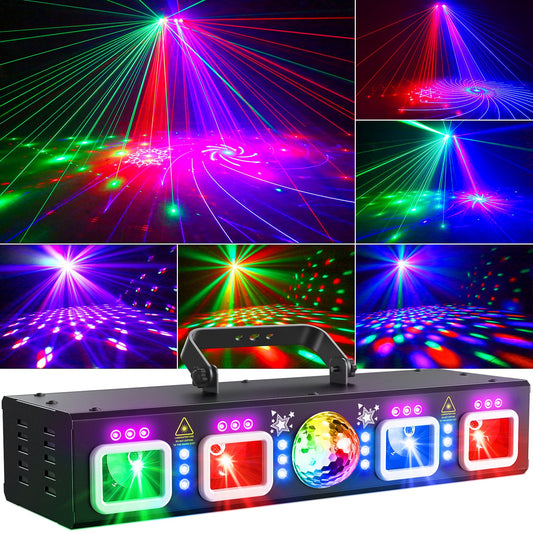
- Premium ($600+): layered battery fixtures, six to eight battery fixtures for focal and ambience, plus a wash on the facade and a focal laser or pattern projector for the dance area. Event-grade without trenching a single cable.
Frequently asked questions
What IP rating do outdoor party lights need?
For anything exposed to open sky, IP65 is the baseline — dust-tight and water-jet resistant. Covered patios can use IP44. Near a pool or in the ground, look for IP67.
Can I use indoor lights outside?
No. Indoor-rated fixtures aren't built for humidity or condensation and become a shock and failure risk outdoors. Use only fixtures marked for outdoor use with a proper IP rating (KeoBin's outdoor party lights are IP65-rated).
How do I power lights with no outdoor outlet?
Battery-powered fixtures are the clean answer — no cable, no GFCI math, place anywhere. If you must run cable, use outdoor-rated lead, a GFCI outlet, and an in-use cover on the connection.
Why do my outdoor lights look harsh?
Almost always color temperature or glare. Use warm white (2700–3000K), hang strings high, and aim uplights at surfaces rather than at eye level.
How many lights do I need for a backyard party?
Coverage depends on space, not headcount. Our room-size and fixture-count guide walks through the math.
Sources & authoritative references
KeoBin's editorial team verifies technical claims against the following independent standards bodies and references:
- Wikipedia — IP Code (ingress protection / weatherproof ratings)
- OSHA — Electrical Safety (outdoor wiring & GFCI)
- Wikipedia — LED lamp (energy-efficient solid-state lighting)
- Wikipedia — Color temperature (warm vs cool light)
- International Dark-Sky Association — light pollution resources
- UL — product safety certification
- Illuminating Engineering Society — lighting design fundamentals
- Wikipedia — Light pollution
Shop KeoBin's outdoor lineup
Ready to light the backyard? These are the KeoBin fixtures we recommend for outdoor setups:
- KeoBin 12×16W Rechargeable Par Lights — 8-hour battery uplights, no cable to the house.
- Shop the full Party & DJ Stage Lights collection for sound-active and app-controlled fixtures.
Related reading
- Rechargeable & Battery-Powered Party Lights: The 2026 Buyer's Guide
- Stage Lighting Safety 101
- Event Lighting by Environment
Background: See the IP Code overview for a quick explanation of enclosure ratings before consulting the applicable product specification.